LANGUAGE FOR FAMILY
Learn the language of the people you love
A new language can be a way into the everyday life of your family. Start with the moments you already share, then practise saying a little more each time.


In this guide
- Choose one ordinary moment worth sharing
- Practise the reply as well as your opening
- Let relatives be relatives
- Make your next session more personal

Choose one ordinary moment worth sharing
You do not need to begin with a whole family dinner. Choose a moment that happens often: getting a child dressed, making breakfast, calling a grandparent, or asking your partner about the day. A familiar setting gives the conversation a purpose before you have many words.
Write down what you genuinely want to say in that setting. Keep the first goal small enough to finish aloud: offer two breakfast choices, ask whether someone is ready, or explain one thing that happened today. The point is to take part, rather than perform a memorized speech.
Practise the reply as well as your opening
A sentence feels different when someone answers. After practising your opening, ask your tutor to respond in two or three plausible ways. Rehearse asking for a slower repeat, checking a meaning, and answering with the words you already know.
For a breakfast conversation, the useful challenge may be hearing a different food preference, not learning ten more food names. Ask for a short roleplay with one small surprise. Repeat it with a new detail so you are making choices rather than reciting a script.
Let relatives be relatives
Ask your partner or family member what kind of help feels comfortable for both of you. They may enjoy a short conversation but dislike correcting every sentence. Agree on a small practice window, and leave room for the relationship to carry on in your shared language.
A private tutor can be a place to repeat, hesitate, and ask the same question again. Then bring one useful phrase into family life. If a child is involved, follow the family’s preferences and keep the exchange playful; your own learning goal does not need to become the child’s responsibility.
Make your next session more personal
Tell Glottie the goal you choose to share: “I am learning European Portuguese so I can speak it at breakfast with my daughter. I am a beginner.” Ask to practise offering breakfast and getting ready to leave, with explanations in English when needed.
The short demo below uses European Portuguese with English support. It is a sample conversation, not a saved family profile. In the app, use your real goals to guide regular practice, and notice what you can now say independently in the moments that matter to you.
YOUR PERSONAL AI LANGUAGE TUTOR
Learn to speak by having a conversation.
The words you recognise on a screen need to become words you can use with another person. Glottie gives you one-to-one speaking practice: listen, find your own words, ask a question, and respond in the moment. Spend your learning time practising the skill you came for.

- Listen
- Reply
- Refine
WHY SPEAKING PRACTICE MATTERS
Build the skill you want to use.
Feedback that helps learning last
A meta-analysis of 15 classroom studies found lasting benefits from oral corrective feedback in second-language learning.
Read the studyPractice that develops spoken fluency
In a small study of Japanese university learners of English, regular video conversations improved fluency and comprehensibility.
Read the studyThe research, in context
Conversation brings listening, recall, and expression together. Feedback helps you notice a gap and try again. Research supports these ingredients of language learning; that is why spoken practice sits at the centre of Glottie.
These studies examined language learning, not Glottie. They do not establish a fixed learning-speed advantage for this app. Progress depends on your starting point, practice, and goals.
YOUR PERSONAL AI LANGUAGE TUTOR
A tutor who knows what you’re working toward.
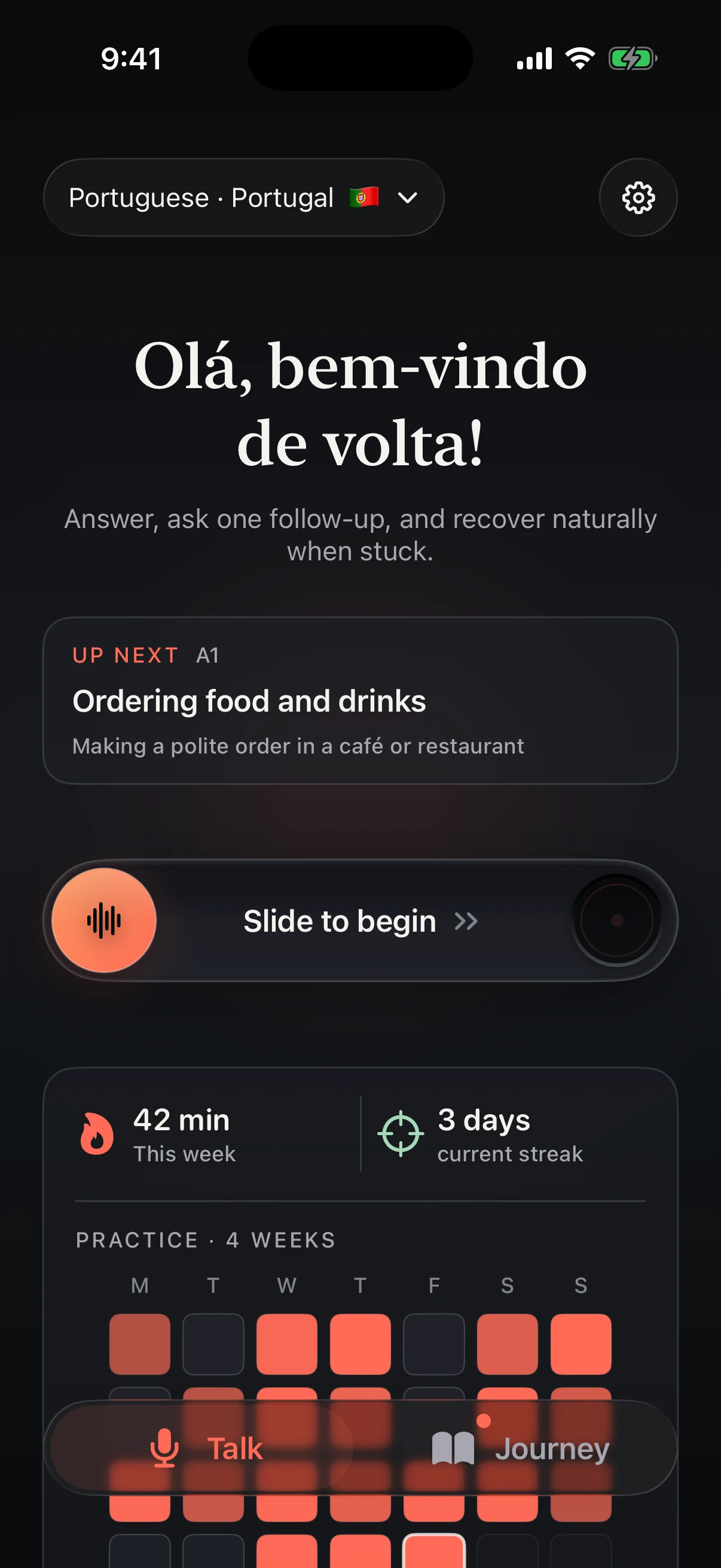
A great private tutor connects each lesson to your life, notices where you struggle, and knows when you’re ready for more. Glottie brings that approach to your iPhone, combining natural AI conversation with a learning path, memory, and review that continue across lessons.
Your reason to learn shapes the lesson
Tell Glottie you want to speak with your partner’s family, raise a bilingual child, or feel at home abroad. Practise breakfast with your daughter, meeting relatives, or talking with a neighbour. Your goals and interests give the conversation a purpose.
The challenge changes with you
Ask for a slower explanation, try the phrase again, or move into a more demanding conversation. Glottie uses your practice and progress to adjust support, revisit difficulties, and build on what you can already do.
Your next lesson remembers the last
Useful preferences, learning goals, and progress carry forward. Review brings earlier material back into practice, while your course gives the conversation direction. You can spend more time on a difficult topic without starting over every day.
Language for the work you actually do
Preparing for a client meeting or an international trip? Tell the tutor about your role and the situations you face. Rehearse introductions, explain a project, and practise relevant vocabulary in context. The goal is useful communication in your world.

NATURAL, TWO-WAY CONVERSATION
Speak freely. Hear a thoughtful reply.
Glottie uses OpenAI’s Realtime API for direct speech-to-speech conversation. You speak aloud and the AI replies in a natural voice, with room to ask questions, practise a response, or ask for help. Glottie adds the teaching structure: your goals, your progress, and a plan for what to practise next.
On demand, day or night, with internet access and available minutes
 Voice technology by OpenAI
 Glottie is an independent app. Your tutor’s voice is AI-generated.
PERSONAL PRACTICE, WITH MORE FLEXIBILITY
A language tutor in your pocket. On your schedule.
Five minutes before work. A conversation after the children are asleep. Glottie makes room for speaking practice when you have time, without booking an appointment. Personal AI tutoring can also cost substantially less than premium private lessons.
Glottie · illustrative hourly cost
Approx.$30USD / hourExample New York private tutor
Approx.$100USD / hourIllustrative comparison · USD per hour
About a third of the hourly cost.
Available around the clock
Minutes per session
One-to-one practice
For this comparison, Glottie is approximately $30 per hour, based on the US Essential plan ($19.99 for 40 monthly minutes) or Steady plan ($49.99 for 100). The Focused plan is $99.99 for 240 minutes. These are monthly plans; the example assumes you use every included minute.
The $100/hour example is the published online rate of New York French tutor Petra Zanki; her in-person rate is $135/hour. This is a specific provider example, not an average or a quote for every language. Tutor rates and package terms vary.
Check current prices: App Store · Petra Zanki · New York
Compare the details
| What matters | Glottie AI tutor | Human private tutor |
|---|---|---|
| When you practise | On demand, day or night, with internet access and available minutes | By appointment, depending on the tutor’s schedule |
| How long you practise | A short five-minute practice or a longer session, up to 60 minutes per session | Session lengths and minimum bookings vary by provider |
| Where you meet | On your iPhone, wherever you can comfortably speak | Online or in person; travel may add time or cost |
| Personal attention | One-to-one AI conversation informed by your goals and progress | One-to-one teaching with human judgment, experience, and rapport |
| What you work on | Adaptive practice, review, and roleplay around your goals | A tutor can customise the lesson and bring specialist expertise |
US prices checked September 6, 2026. Local App Store prices may differ. Monthly minutes expire at renewal; unused minutes increase the effective hourly cost. Internet access, account eligibility, and service availability apply.
READY TO SPEAK
A useful conversation is a good place to start.
Continue in Glottie with the matching language pair. Choose the situations that matter to you and build regular speaking practice around your goals.
YOUR QUESTIONS, ANSWERED
Getting more from your personal language tutor.
How does conversation help me learn European Portuguese?
Speaking asks you to understand another person, recall words, and express your own meaning. Glottie gives you practice doing those things together, with explanations and chances to try again. Research on interaction and oral feedback supports this approach. Reading and vocabulary study can complement it, but spoken practice directly exercises the skill you want to use in conversation.
How quickly can I improve my spoken European Portuguese?
Your starting point, practice, and goals all affect how quickly you improve. Glottie helps you use your time purposefully: speak regularly, work at an appropriate challenge, review what needs attention, and connect lessons to your life. We do not claim that it makes you fluent twice as fast as another app or a human tutor; that would require a direct study of Glottie learners.
Is this a real person or an AI tutor?
You are speaking with an AI tutor using OpenAI’s Realtime speech-to-speech technology. It can hold a natural voice conversation and respond to your questions. Glottie supplies the learning path and memory around that conversation. It is not a human, and it can make mistakes; it does not replace every kind of support or expertise a human teacher can offer.
Which languages does the demo on this page use?
The demo uses European Portuguese, with English for explanations, as an example. Its target variety is European Portuguese as spoken in Portugal. Choose an available language pair in the app to make your own lessons relevant to the conversations you want to have.
Will the tutor remember my goals and progress?
Glottie carries useful learner-supplied preferences and goals between lessons, alongside your practice and progress. That helps the tutor choose relevant examples, revisit difficult material, and plan the next challenge. Tell it what matters to you, and correct it if a preference or goal has changed.
Can lessons focus on my family, job, or a specific industry?
Yes. Tell Glottie about the conversations you want to have: speaking with your partner’s family, caring for your child, settling abroad, or discussing a project with colleagues. You can ask to practise vocabulary, phrases, and roleplay related to your work. Revisit a useful topic over several lessons, then try the same language in a new situation.
Can I use Glottie as a complete beginner?
Yes. Choose A0 if you are starting from scratch, then select a plan to begin. You can use English for help, ask the tutor to slow down, and practice small exchanges before longer conversations. Your selected level is a starting preference, not a test result.
Can I practise for five minutes, and is it available at night?
You can start on demand, day or night, with an internet connection and available minutes. Stop after a short practice or continue for up to 60 minutes in one session. Paid sessions require at least five minutes of credit to start. Plans have minute allowances; practice is not unlimited and service availability can vary.
How does the price compare with a private language tutor?
Glottie’s US plans are $19.99 for 40 monthly minutes, $49.99 for 100, and $99.99 for 240. Using all the Essential or Steady minutes works out to approximately $30 per hour. The illustrated private-tutor example is Petra Zanki’s published $100/hour online rate in New York: Glottie costs about a third as much in this comparison. Other tutors may charge less, and unused monthly minutes increase Glottie’s effective hourly cost. Current local pricing appears in the App Store.
Can I try a conversation before downloading the app?
When the website demo is available, choose a situation on this page and start a short AI conversation. Your browser asks for microphone permission, and your audio goes to OpenAI to provide the conversation. The demo is limited and may be unavailable when its daily allowance is used. Download Glottie for the full learning experience and ongoing progress.